Latest Posts
View the latest posts in an easy-to-read list format, with filtering options.
View the latest posts in an easy-to-read list format, with filtering options.
Multi-part posts on a particular topic, grouped together in "series" pages.
Look through our blog archive by year / month, or in a massive title list.

03/20/2026 - The present war with Iran is not new. What we are seeing is just the latest escalation of a war th... Read More
03/20/2026 - 1 Peter 4:1, 2 says, 1 Therefore, since Christ has suffered in the flesh, arm yourselves also with... Read More
03/19/2026 - Peter’s first letter was addressed to some groups of ex-Israelites whose ancestors had been... Read More
Read over 100 books written by Dr. Jones, available to read for free online. Several of the books have also been translated into different languages, and are also available to read for free. The only time you pay is when you purchase a physical version of a book.
View Full Book List


Read a variety of tracts that condense a topic into a short, single page format. These tracts can be read for free online, or physical copies can be purchased in bundles. If you are subscribed to the FFI Newsletter, you will receive new tracts when they are released.
View Full Tract ListThe first chapter of Nahum set forth God’s nature, showing how the justice of God springs from His goodness and mercy. The second chapter shows God’s nature in action or implementation as He brings judgment upon Nineveh.
Nahum 2:1, 2 begins,
1 The one who scatters has come up against you [Nineveh]. Man the fortress, watch the road; strengthen your back, summon all your strength. 2 For the Lord will restore the splendor of Jacob like the splendor of Israel, even though devastators have devastated them and destroyed their vine branches.
Nahum 2:1, 2 marks the shift from threats to specific judgment: the “scatterer” rises against Nineveh, signaling its downfall. Even as Nineveh had scattered many nations by their policy of transplanting populations, so also will God scatter them. The judgment fits the crime as in “eye for eye” (Exodus 21:24), and in this case, it would be “scatter for scatter.”
The word to Nineveh drips with irony, telling the Ninevites to strengthen their defenses to see if they might be able to withstand divine judgment. Such defenses, of course, are in vain, for God always wins in the end.
Yet for God’s people, the same act is one of restoration. Their majesty, once stripped by Assyrian violence, is being renewed. One might ask how God may “restore the splendor of Jacob like the splendor of Israel.” Jacob is the name of the soulish man; Israel is the name of the spiritual man, that is, the overcomer.
Jacob was a believer who received revelation long before he received the name Israel. Yet as Jacob, he thought it was necessary to help God fulfill the prophecy given to his mother before he was born. In fact, he was even willing to lie to secure its fulfillment. Only later did he learn that God needs no help from the flesh to fulfill His promise. After wrestling with the angel, he learned the vital lesson that God was indeed sovereign, thereby receiving the name Israel, “God rules.” To be adorned by that name is “the splendor of Israel.”
Therefore, the revelation of Nahum is that even as Jacob became Israel, so also would believers become overcomers. This was in spite of the devastation that Nineveh had brought upon the house of Israel. The tribes of Israel, which Nineveh deported to the land of Gamir were not to be lost forever but were to be transformed into true Israelites. Paul tells us in 1 Corinthians 15:46,
46 However, the spiritual [Israel] is not first, but the natural [Jacob]; then the spiritual.
This is the pattern for us all. We are all born first in a natural way as soulish people through Adam, the “living soul” (1 Corinthians 15:45). We must later be begotten by the Spirit and “born again” in order to become like Christ, the “life-giving spirit.” In a legal sense, Jacob and Israel represent two individuals, which Paul calls the old man and the new man. When we allow the old man to be crucified with Christ (Romans 6:6), we take on a new identity, that is, the new man. As such we become “a new creature” (2 Corinthians 5:17) in the eyes of the law.
This transformation, of course, was ultimately the “change” that Paul mentioned in 1 Corinthians 15:51, an event which awaits the work of Christ in His second coming. Though only a few will qualify as overcomers at the first resurrection, ultimately all will come to know Him through the judgments of our Good God (Hebrews 8:11). This is the promise of the New Covenant, which was established by God’s oath (Deuteronomy 29:12-15).
Nahum 2:2 alludes to this promise, calling it “splendor” (or majesty). The nature of that splendor is seen in Christ’s transfiguration on the mount in Matthew 17:2.
Nahum 2:3, 4 describes Nineveh, saying,
3 The shields of his mighty men are colored red [adum, “red, blood-colored”], the warriors are dressed in scarlet [shani], the chariots are enveloped in flashing [or “polished”] steel when he is prepared to march, and the cypress spears are brandished. 4 The chariots race madly in the streets, they rush wildly in the squares, their appearance is like torches, they dash to and fro like lightning flashes.
Their shields were often painted red for intimidation, as if to say that they had already shed the blood of many in the battle. As for the scarlet uniforms, shani refers to a dye produced from insects, not just a color. It came from the dried bodies of the coccus ilicis (or related species), a small insect that lived on oak trees. When crushed, these insects produced a deep red dye.
Such dyed cloth was expensive in those days and was worn only by the wealthy class. It is not likely that an entire army go into battle dressed in scarlet, where their garments could quickly be ruined. More likely, Nahum was describing the prophetic overthrow of “Nineveh” in the latter days, where Nineveh represents an oppressive but wealthy world empire at the end of the age.
In this sense, Nineveh is like Babylon and Tyre, which also represent commercial systems that extend far beyond their original borders. If we view Nineveh as another prophetic name of the world system that now controls the world, the “chariots” racing madly in the streets may be a reference to automobiles racing down the highways. To Nahum, they were chariots. At night, with their headlights, “their appearance is like torches.”
The majority of commentators believe that Nahum 2:3, 4 describes the army invading Nineveh, but this is far from clear. The minority opinion is that it describes Nineveh. If we apply the description to the world empire in our time, it appears to better describe urban life in a modern city, rather than merely the siege of ancient Nineveh. In my view, when Babylon overthrew Nineveh, it established the original pattern of the empire’s collapse, but this is now being repeated on a much greater level with different weapons and tactics.
Nahum 2:5-7 says,
5 He remembers his nobles; they stumble in their march, they hurry to her wall, and the mantelet [sawkak] is set up. 6 The gates of the rivers are opened and the palace is dissolved. 7 It is fixed [hutzav, “it is decreed, established”]; she is stripped, she is carried away, and her handmaids are moaning like the sound of doves, beating on their breasts.
The Assyrian king tries to rally his nobles in defense of the wall, but “they stumble” in their chaotic defense. A “mantelet” (sawkak) has been set up. This is an old military term for a movable protective shield, a covered shelter, or a siege tower used by those trying to breach the walls of a city.
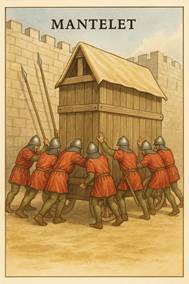
In verse 6, “The gates of the river are opened.” Diodorus Siculus, an ancient historian, records that Nineveh fell when the Tigris River (or tributaries) flooded and broke part of the city wall. “The palace is dissolved” (or “melts away”). It either literally collapses from flooding, or figuratively “dissolves” as power and stability vanish.
Verse 7 tells us that the dissolution of power is “decreed” (by God). The KJV treats the word as a proper name (Huzzab). Dr. Bullinger says that if it is a proper name, then it may be the queen or queen-mother of the city, as well as being a personification of Nineveh itself. If that is the case, then it points to the next phrases, “she is stripped, she is carried away.” However, most scholars think this interpretation is unlikely, since the grammatical form of hutzab is verbal, not nominal.
However we choose to interpret this, it is clear that it pictures the fall of Nineveh in 612 B.C. and that modern Nineveh too is guaranteed to fall. Other cities such as Jerusalem and Babylon were often personified as women.

Dr. Stephen Jones has been writing blog posts since 2005 on a variety of topics from Bible Studies to World News, and he has been writing books since 1992. Dr. Jones' most important writings came after God brought him back into the full-time ministry in 1991. It is here that all his earlier years of searching the Scriptures began to come into clear focus. He combines a knowledge of the Old and New Testaments with a personal revelation of God that began and developed during the "wilderness" period of his life, which he often refers to as God's True Bible College... Read More
We are only able to do what we do because of your support. If you feel led to support this ministry, we deeply appreciate it