Latest Posts
View the latest posts in an easy-to-read list format, with filtering options.
View the latest posts in an easy-to-read list format, with filtering options.
Multi-part posts on a particular topic, grouped together in "series" pages.
Look through our blog archive by year / month, or in a massive title list.
03/18/2026 - 1 Peter 3:18-20 says, 18 … [Jesus] having been put to death in the flesh, but made alive in... Read More
03/17/2026 - 1 Peter 3:13-17 says, 13 Who is there to harm you if you prove zealous for what is good? 14 But ev... Read More
03/16/2026 - The Prayer Principle Why does Peter tell husbands to honor their wives so that their prayers will... Read More
Read over 100 books written by Dr. Jones, available to read for free online. Several of the books have also been translated into different languages, and are also available to read for free. The only time you pay is when you purchase a physical version of a book.
View Full Book List

Read a variety of tracts that condense a topic into a short, single page format. These tracts can be read for free online, or physical copies can be purchased in bundles. If you are subscribed to the FFI Newsletter, you will receive new tracts when they are released.
View Full Tract ListNahum 3:8-10 says,
8 Are you [Nineveh] better than No-amon [i.e., Thebes], which was situated by the waters of the Nile, with water surrounding her, whose rampart was the sea, whose wall consisted of the sea? 9 Ethiopia was her might, and Egypt, too, without limits. Put [Libya] and Lubim [Libya west of Egypt] were among her helpers. 10 Yet she became an exile, she went into captivity; also her small children were dashed to pieces at the head of every street; they cast lots for her honorable men, and all her great men were bound with fetters.
Thebes was the capital of Upper Egypt. Located on the Nile, Thebes had great natural defenses: canals, waterways, and surrounding terrain gave it the sense of being impregnable (“whose wall was the sea”).
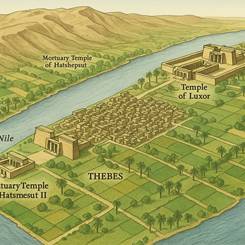
Thebes had an unbeatable coalition of allies, but yet in 663 B.C. Thebes was conquered by the Assyrian king Ashurbanipal.
Ashurbanipal himself recorded the conquest of Thebes (No-Amon) in 663 BC, boasting of its plunder and captives. The Rassam Cylinder of Ashurbanipal (British Museum) reads:
“I conquered Thebes (Niʾi), the whole city. Silver, gold, precious stones, the treasures of his palace, garments with multicolored trim, fine horses, people, male and female, two lofty obelisks, weighing 2,500 talents, I removed from their place and took to Assyria. I carried away captives, male and female. I counted as spoil its countless goods.”
Nahum 3:8–10 compares Nineveh to Thebes (No-amon, “The City of Amun-Ra,” the supreme god of the Egyptian pantheon). Thebes is today called Luxor/Karnak. Just as Thebes went into exile, saw its children killed, and its nobles enslaved, so too will Nineveh fall. The lesson: no city, however mighty, can withstand the judgment of God.
So also the prophetic manifestation of Nineveh/Babylon will fall, no matter how powerful it seems to be.
Nahum 3:13 continues,
13 Behold, your people are women in your midst! The gates of your land are opened wide to your enemies; fire consumes your gate bars.
In ancient warfare imagery, calling soldiers “women” was not a statement about gender but about weakness and vulnerability in the face of attack. The Assyrians themselves used similar taunts in their records, boasting that their enemies became “like women.”
Gates are symbolic of defense and security as well as government administration. This was the case in the cities of Israel (Deuteronomy 21:19; Proverbs 31:23) as well as in foreign cities. Excavations at Nineveh and other Assyrian cities reveal gate complexes with chambers large enough for administrative activity.
Cuneiform tablets describe gates as sites where royal decrees were posted and disputes settled. In Assyrian art, gate areas often show officials — the gateway marked the intersection of public life, military defense, and civic order.
In Egyptian cities, the temple often functioned as the judicial center, but city gates also bore inscriptions and served as checkpoints. Egyptian texts sometimes speak of “judging at the gate” (similar to Mesopotamian practice). At Thebes, officials and scribes would often record decrees or conduct hearings at entryways, since gates symbolized the boundary of order and authority.
To say they are “opened wide to your enemies” means total exposure and inability to resist invasion. This prophecy was historically fulfilled in 612 B.C. when the Medes and Babylonians broke through Nineveh’s defenses. Some sources suggest floodwaters helped breach the walls.
To “possess the gate” of enemies (Genesis 22:17) meant to have political/military dominance. To “burn the gates” or see them “broken down” was to symbolize the collapse of authority and law, not just fortifications.
Prophetic Nineveh/Babylon today has not only a powerful military (mainly centered in the USA) but also has government and judicial institutions. These “gates” are being challenged today.
Nahum 3:14 says,
14 Draw for yourself water for the siege! Strengthen your fortifications! Go into the clay and tread the mortar! Take hold of the brick mold!
In a siege, water supplies were critical — armies would cut them off to starve a city into surrender. Nineveh, surrounded by rivers and canals, had abundant water sources. Yet Nahum sarcastically tells them to store up, as if this could prevent their fall. The implied irony is that no amount of stored water will save them from the flood and fire of God’s judgment (Nahum 1:8; 2:6).
God calls Nineveh to “Strengthen your fortifications!” Patch the walls and reinforce the defenses. But again the irony is that Nineveh’s famed walls (some 100 feet high, 40–50 feet thick, with massive towers) would not stand when God decreed judgment.
God tells Nineveh to “Go into the clay and tread the mortar! Take hold of the brick mold!” This describes the labor of repairing or building defensive walls. Assyria was known for massive brickwork; Nineveh’s defenses were reinforced with mudbrick on stone foundations. But the prophet mocks them: “Make more bricks, work harder, shore up your walls — it won’t matter.”
Nahum 3:15 continues,
15 There fire will consume you, the sword will cut you down; it will consume you as the locust does. Multiply yourself like the creeping locust [yeleq, “devourer”], multiply yourself like the swarming locust [arbeh, “the numerous one, the great multiplier”].
Fire is one of the stock images of divine judgment, most notably in God’s destruction of Sodom and Gomorrah. Historically, when Nineveh fell in 612 BC, the city was burned — archaeological evidence confirms widespread destruction by fire. This fulfills the warning: no matter how many bricks they mold, the walls themselves will be devoured by flames.
The locust is a classic Near Eastern symbol of overwhelming, unstoppable devastation. Here, the image is of an unstoppable swarm stripping Nineveh bare — just as Nineveh had stripped other nations. The “creeping locust” emphasizes its ability to eat all vegetation; the “swarming locust” emphasizes its sheer numbers that overwhelm all defenses.
Joel 1:4 lists four stages in the life cycle of locusts (gazam, arbeh, yeleq, and hasil). Each is a progression of divine judgment, which (to those with spiritual discernment) gives opportunity to repent or to prepare for an inevitable collapse. Nahum 3:15 mentions the second and third only, with a sarcastic command: “Go ahead, increase your numbers, grow as vast as a locust swarm.”
Even if Nineveh multiplies its armies and population, they will vanish like locusts (verses 16–17). The prophet turns Nineveh’s supposed strength (its vast numbers and wealth) into an image of futility — swarms that appear mighty but soon disappear.

Dr. Stephen Jones has been writing blog posts since 2005 on a variety of topics from Bible Studies to World News, and he has been writing books since 1992. Dr. Jones' most important writings came after God brought him back into the full-time ministry in 1991. It is here that all his earlier years of searching the Scriptures began to come into clear focus. He combines a knowledge of the Old and New Testaments with a personal revelation of God that began and developed during the "wilderness" period of his life, which he often refers to as God's True Bible College... Read More
We are only able to do what we do because of your support. If you feel led to support this ministry, we deeply appreciate it