Latest Posts
View the latest posts in an easy-to-read list format, with filtering options.
View the latest posts in an easy-to-read list format, with filtering options.
Multi-part posts on a particular topic, grouped together in "series" pages.
Look through our blog archive by year / month, or in a massive title list.
03/16/2026 - The Prayer Principle Why does Peter tell husbands to honor their wives so that their prayers will... Read More

03/15/2026 - Paula White is said to be President Trump’s pastor. Because of her profound ignorance of Scr... Read More
03/14/2026 - The US Air Force struck the military airfield at Iran’s Kargh Island yesterday, with photos... Read More
Read over 100 books written by Dr. Jones, available to read for free online. Several of the books have also been translated into different languages, and are also available to read for free. The only time you pay is when you purchase a physical version of a book.
View Full Book List


Read a variety of tracts that condense a topic into a short, single page format. These tracts can be read for free online, or physical copies can be purchased in bundles. If you are subscribed to the FFI Newsletter, you will receive new tracts when they are released.
View Full Tract ListIn the tenth chapter of Daniel, we read how the prophet had been fasting for 21 days. The reason for the fast is not stated, but presumably he was praying for Judah’s captives in Babylon to be released. The date is given as “the third year of Cyrus” (Daniel 10:1), but we know that his father-in-law, Darius the Mede, was ruling Babylon for about 3 years in place of Cyrus (Daniel 5:31), while Cyrus himself continued his conquests.
When Cyrus returned to rule personally, Darius went back to Media. So Ezra 1:1 tells us that the Edict of Cyrus, allowing the captives to return to their home countries, was decreed “in the first year of Cyrus” (534 B.C.). This was actually the first year that Cyrus personally took the throne. Darius ruled from 537-534 B.C. The people of Judah were allowed to return in the Spring of 534.
Daniel’s prayer (with fasting) must have taken place just before Cyrus made his decree, showing how God answered his prayer rather quickly. In the account, after 21 days of fasting, an unnamed angel appeared to Daniel, telling him that his prayer had been answered from the start of his prayer. However, the angel had not been able to inform the prophet for 21 days, because the Prince of Persia had withstood him (Daniel 10:13). Nonetheless, this angel was able to break through enemy lines when “Michael, one of the chief princes” came to assist.
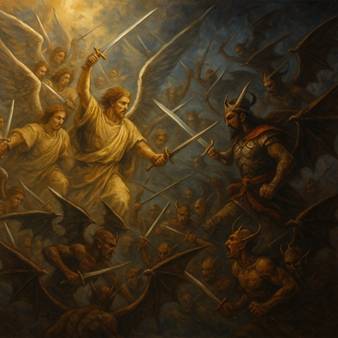
This implied that there was a spiritual battle going on in the heavens, which apparently the prophet was unaware of until that moment of revelation. When the message was delivered, we read in Daniel 10:20,
20 Then he said, “Do you understand why I came to you? But I shall now return to fight against the prince of Persia; so I am going forth, and behold, the prince of Greece is about to come.”
This gives us an insightful glimpse into spiritual events that take place without the knowledge of men on earth (apart from divine revelation). We are given few details, but what we are given is very important, forming the basis of our own revelation that is built upon it.
These heavenly battles were directly connected to the succession of beast empires revealed in Daniel 2 and 7. If there is a “prince of Persia” and “the prince of Greece,” what about the Prince of Babylon and the Prince of Rome? Just as God has Archangels with specific callings and power to fight as extensions of God’s sovereignty, so also is there an evil opposing side that has princes and (I believe) Archprinces.
Whereas most evil spirits are low-level grunts who occupy small portions of territory (mostly by possessing individual people), there are others who rule over cities, tribes, even some churches, denominations, organizations, nations, and empires. Each level requires its own rank in exercising authority under Satan himself.
Persia was the ruling empire at the time the angel visited Daniel. The Prince of Persia was thus empowered (by God’s law) in the same way that Babylon had been empowered earlier. These had received power because Jerusalem had rejected the law of God and the word of the prophets and had refused to repent. Hence, the law required judgment against Jerusalem, and God told Jeremiah that the Judge had given Judah and Jerusalem (and other nations) into the hands of “Nebuchadnezzar king of Babylon, My servant” (Jeremiah 27:6).
Nebuchadnezzar, then, was the earthly authority manifesting the spiritual authority of the Prince of Babylon. Just as Michael was Daniel’s “prince” (Daniel 10:21), so also was the Prince of Babylon the prince who ruled and motivated King Nebuchadnezzar and his successors. Most people have so-called “guardian angels” who are “ministering spirits, sent out to render service for the sake of [or on behalf of] those who will inherit salvation” (Hebrews 1:14). But some, like Daniel, have greater spiritual authority, defined by higher-level angels such as princes and archangels.
To say that God and His angels always have the power to defeat Satan and his angels is too simplistic. While this is certainly true in a theoretical sense, the law of God (reflecting His nature) shows that all sin must be judged. God uses judgment to bring people and nations to repentance, but yet they remain in captivity or bondage until they do repent. Because of this, God has limited Himself to follow the protocol set forth in His law. This means that restoration is postponed or delayed for specific amounts of time according to the ruling of the divine court.
So God expelled Adam and Eve from the Garden of Eden, so that they would not eat of the tree of life and become immortal sinners. This postponed the release of all creation into the glorious freedom of the children of God (Romans 8:19-21). God will always win in the end, and the restoration of all things will surely come (Acts 3:21), but only after the judgments of God have run their course.
Daniel 10 paints the picture of open warfare between two sides. Sin empowers the side of evil, because the law judges sinners, and “the sting of death is sin, and the power of sin is the law” (1 Corinthians 15:56). Sin empowers the law to sell them into bondage. Apart from sin, the law has no claim on us, because its function is to judge sin (lawlessness). But when Israel and Judah sinned and refused to repent, the law sold them as slaves to various nations in the book of Judges and later to Assyria and Babylon.
The nature of the battle is ultimately a matter of law. The winner is the one who is justified by the Judge; the loser is the one condemned by the Judge. In Daniel 10 this battle remained undecided, it seems, until Daniel repented on behalf of the nation in Daniel 9:4-19. Daniel had spiritual authority over Judah and was therefore in a position to repent on its behalf.
Daniel’s prayer of repentance was made in 537-536 B.C. “in the first year of Darius.” Two years later, he had seen no change in Judah’s status, yet he recognized that the nation had finally reached 70 years of captivity (Daniel 9:2). The 70-year captivity was from 604-534 B.C. Hence, he sought understanding of the divine plan in Daniel 10.
The 70-year verdict in the divine court (in the days of Jeremiah) had almost concluded. The two opposing sides of the conflict were still equal in strength until the terms of the sentence of the law were fulfilled. Only then could victory for Judah be accomplished, and then the next era of lesser judgment arrived. Judah’s iron yoke (under Babylon) was removed and replaced by a wooden yoke (under Persia).
Of course, two centuries later, in 332 B.C. the battle again shifted from Persia to Greece, when Alexander the Great took the city of Jerusalem. We can extrapolate from this that in 63 B.C. the prince of Rome took control of Jerusalem, and so the heavenly battle shifted once again to a new adversary in the divine court.
In 1988, while I was in the Net of Prayer, I participated in a spiritual battle against the Prince of Persia. Revelations leading to this battle began to flow as early as March of 1986. During this time, I learned that the actual name of the Prince of Persia was Apollyon (in Greek) and Abaddon (in Hebrew). These names are set forth in Revelation 9:11.
It was also revealed to me that the nameless angel in Daniel 10 was Peniel, the angel that Jacob wrestled in Genesis 32:29, 30. So he named that particular place after the name of the angel. Peniel was the angel’s name; Penuel was the place (Genesis 32:31; Judges 8:8; 1 Kings 12:25).
It takes an Archangel to overthrow an Archprince, because they are of comparable rank, though one is from God and other from Satan. Moreover, Peniel is the Archangel that has the specific calling and authority to overthrow Apollyon/Abaddon, the Archprince of Persia.
We learned this by hard experience in a later battle (2001), when we sent Michael to bind Apollyon. We quickly discovered that our angels were being overcome. We had broken protocol, and this had given grounds to the enemy. We had to appear before the Judge in the divine court to repent, make the correction, and straighten out the mess. This was successful, but from that point on, our enemies knew who we were, because we all had to appear before the Judge in the same courtroom. Up to then, they did not know who was battling them.
It all worked out for good, of course, but we lost the advantage of anonymity. That was the price we paid for our mistake.
In Part 2 we will examine the actual nature and calling of the Prince of Persia and how Peniel acts as a counterforce against him.

Dr. Stephen Jones has been writing blog posts since 2005 on a variety of topics from Bible Studies to World News, and he has been writing books since 1992. Dr. Jones' most important writings came after God brought him back into the full-time ministry in 1991. It is here that all his earlier years of searching the Scriptures began to come into clear focus. He combines a knowledge of the Old and New Testaments with a personal revelation of God that began and developed during the "wilderness" period of his life, which he often refers to as God's True Bible College... Read More
We are only able to do what we do because of your support. If you feel led to support this ministry, we deeply appreciate it