Latest Posts
View the latest posts in an easy-to-read list format, with filtering options.
View the latest posts in an easy-to-read list format, with filtering options.
Multi-part posts on a particular topic, grouped together in "series" pages.
Look through our blog archive by year / month, or in a massive title list.
02/04/2026 - Ecclesiastes 11:7, 8 says, 7 The light is pleasant, and it is good for the eyes to see the sun. 8... Read More
02/03/2026 - Ecclesiastes 11:5 says, 5 Just as you do not know the path of the wind and how bones are formed in... Read More

02/02/2026 - Sorry, the report about Trump that I posted earlier is probably just an AI-generated attack. I pos... Read More
Read over 100 books written by Dr. Jones, available to read for free online. Several of the books have also been translated into different languages, and are also available to read for free. The only time you pay is when you purchase a physical version of a book.
View Full Book List
Read a variety of tracts that condense a topic into a short, single page format. These tracts can be read for free online, or physical copies can be purchased in bundles. If you are subscribed to the FFI Newsletter, you will receive new tracts when they are released.
View Full Tract ListThe Colossians lived in the ancient city of Colossae which, in the first century, was a declining commercial center about 100 miles east of Ephesus. It was situated on the Lycus Valley caravan route about 10-12 miles from Laodicea.
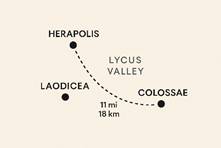
It appears that many of the local inhabitants were actually descended from the “lost tribes” of Israel, having spread west from the land of Gamir where the Assyrians had relocated them 700 years earlier. Being separated by distance from Jerusalem, the Talmud criticizes them for deviating from standard Judaism, saying, “the wines and baths of Phrygia had separated the ten tribes from their brethren” (Shabbath, 147b).
Peter preached to some of these ex-Israelites, later writing to them his first epistle. 1 Peter 1:1 addresses them in this way:
1 Peter, an apostle of Jesus Christ, to those who reside as aliens scattered [lit., “aliens of the diaspora”] throughout Pontus, Galatia, Cappadocia, Asia, and Bithynia, who are chosen.
The Jewish diaspora was yet a future event, coming after the destruction of Jerusalem in 70 A.D. and the Bar Kochba war (132-135 A.D.) He later distinguishes these ex-Israelite believers from the Jews in 1 Peter 2:7-10, saying,
7 This precious value, then, is for you who believe; but for those who disbelieve, “The stone which the builders rejected, this became the very corner stone,” 8 and, “A stone of stumbling and a rock of offense”; for they [unbelieving Jews] stumble, because they are disobedient to the word, and to this doom they were also appointed. 9 But you [believers among the ten-tribes] are a chosen race, a royal priesthood, a holy nation, a people for God’s own possession… 10 for you were once not a people [Lo-ammi], but now you are the people of God; you had not received mercy [Lo-ruhamah], but now you have received mercy.
Peter was referring to the prophecy of Hosea, who pronounced judgment against the House of Israel, calling them children of harlotry. He named his children prophetically: Lo-ammi, “Not My People,” and Lo-Ruhamah, “Not Pitied” (i.e., No Mercy), showing that those Israelites were no longer to be considered “the people of God.” Yet Hosea also speaks of redemption through a New Covenant, by which they were to receive mercy and be restored as “My People.” Peter makes it clear, however, that their restoration could come only by faith in Christ, the Mediator of the New Covenant. They could not claim to be “chosen” or “the people of God” by their genealogy but by faith in Christ alone. Indeed, it was the same with the Jews.
Colossae was situated south of the provinces named in Peter’s first epistle. Because Peter did not mention Colossae, it is doubtful that he was the founder of that church. In fact, Colossae was close to Laodicea, where Paul ministered. The church was founded by Epaphras (Colossians 1:7), one of Paul’s co-workers, who likely heard the gospel from Paul during his ministry in Ephesus (Acts 19:10). As Epaphras was Paul’s deputy, the church at Colossae naturally looked to Paul himself for leadership. Colossians 2:1 addresses “all those who have not personally seen my face,” suggesting that Paul himself had never preached in Colossae.
It is also of interest to note that Colossae was not one of The Seven Churches in Revelation 2 and 3. Hence, this church does not represent any particular church age within the Pentecostal Age as do The Seven Churches addressed by John.
Epaphras traveled to Rome (where Paul was imprisoned) to inform Paul about problems in the church.
Paul’s central theme is the supremacy and sufficiency of Christ. No New Testament letter gives a higher, more exalted picture of Christ. Christ’s work affects not just individuals but the entire creation (Colossians 1:20). Paul wants believers to understand that “in Him you have been made complete” (Colossians 2:10). No amount of Old Covenant rituals, human traditions, ascetic practices, or Gnostic mysticism can add to that which has already been accomplished by Christ.
Paul admonishes the church to “set your mind on the things above, not on the things that are on earth” (Colossians 3:2). Hence, it appears that Epaphras reported to Paul about certain influences seeping into the church from Judaism, Greek philosophy (Epicureanism), and Gnosticism.
According to The Wycliffe Bible Commentary, page 1334, “one-fourth of Colossians is found in Ephesians,” showing the close connection between these two epistles. Likewise, there is a close connection between Colossians and Galatians, because Paul deals with the same tendency to slide back into Old Covenant Judaism. The same connection can be made with the book of Hebrews. Paul worked hard against those who would displace Christ with religious forms and rituals, which he viewed as mere types and shadows of better things—heavenly things brought by the New Covenant.

Dr. Stephen Jones has been writing blog posts since 2005 on a variety of topics from Bible Studies to World News, and he has been writing books since 1992. Dr. Jones' most important writings came after God brought him back into the full-time ministry in 1991. It is here that all his earlier years of searching the Scriptures began to come into clear focus. He combines a knowledge of the Old and New Testaments with a personal revelation of God that began and developed during the "wilderness" period of his life, which he often refers to as God's True Bible College... Read More
We are only able to do what we do because of your support. If you feel led to support this ministry, we deeply appreciate it