Latest Posts
View the latest posts in an easy-to-read list format, with filtering options.

View the latest posts in an easy-to-read list format, with filtering options.
Multi-part posts on a particular topic, grouped together in "series" pages.
Look through our blog archive by year / month, or in a massive title list.
03/21/2026 - Iran's Sampson Card | Armstrong Economics Iran threatened to strike “Israel’s”... Read More

03/21/2026 - I made a couple of date corrections in yesterday’s blog, where I had written that the first... Read More
03/20/2026 - The present war with Iran is not new. What we are seeing is just the latest escalation of a war th... Read More
Read over 100 books written by Dr. Jones, available to read for free online. Several of the books have also been translated into different languages, and are also available to read for free. The only time you pay is when you purchase a physical version of a book.
View Full Book List
Read a variety of tracts that condense a topic into a short, single page format. These tracts can be read for free online, or physical copies can be purchased in bundles. If you are subscribed to the FFI Newsletter, you will receive new tracts when they are released.
View Full Tract ListMy 20th and final physical therapy session was last Thursday. I was tested once again and showed good improvement on all fronts. I could have signed up for another 90 days of treatments, but I decided to stop for the winter. If I feel the need for faster improvement, I will have the option to resume physical therapy later, perhaps in March 2026.
One of the tests was to see how far I could walk in 2 minutes. Last September, before starting therapy, I walked 386 feet. After 10 sessions, this was increased by 50 feet. Last Thursday this increased another 50 feet with no stumbling. This indicates increased speed and quality as well.
We have not seen the ground since last month. We have about a foot of snow on the ground, and yesterday morning the temperature was -9 F (or about -23 C).
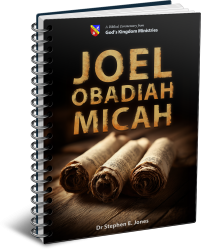
We just published a single book with commentaries on 3 of the Minor Prophets: Joel, Obadiah, and Micah ($25). Sorry that we had to raise the price, as printing costs have gone up—along with everything else.
I am planning to publish another “3 books in 1” from the New Testament shortly: Philippians, Philemon, and Colossians. It is more efficient to combine these shorter books into a single spiral-bound book. This should be ready in January. I will let you know when it is available.
In addition, I have been editing some books which my friend Roger Boatman has written. He compiled quite a bit from my weblogs but also added a lot of his own thoughts. This has kept me busy as well, and I will let you know when these are available and how to order them from him.
As you may recall, I have said for more than a decade that when the price of silver reaches $50/oz, it would signal the collapse of the banking system which is the economic lifeblood of Mystery Babylon today. It took only 12 days for the price to go from $50 to $60. It is now $63-64/oz and heading toward $70 and $80.
I heard a commentator say that the large American banks have closed out their short positions and are now going long (i.e., purchasing silver). They began to close out their shorts last June, and this probably explains why the price has doubled in the last 6 months.
From 1450-1530 the international reserve currency was the Portuguese cruzado. But Spain began stealing gold from South America in the early 1500’s. By 1530 the Spanish real (dollar) had replaced the Portuguese cruzado as the main reserve currency.
Then in 1545 a Spanish explorer discovered a mountain of silver in Bolivia and began shipping it back to Spain. It was in the middle of nowhere, and they had to import all their food and water, but at the base of the mountain, they built a large European city called Potosi, which was larger than Paris and had all of the culture of Paris. The population of Potosi was 160,000.
Meanwhile, the increase in money supply in Spain caused prices to rise, and from 1500-1650 wages and prices rose $150%. It soon became cheaper to buy things from other European nations. Spain went down the path of de-industrialization, because they could use their silver to buy cheaper goods and food elsewhere. So all that silver from Bolivia went to other countries, The Netherlands in particular, which became an industrial powerhouse.
Spain defaulted 9 times in a century—four of these during the reign of King Philip II (1557, 1560, 1575, 1596). Think of that. The Potosi silver mine was discovered in 1545, and just 12 years later (1557), Spain was already bankrupt!
The Dutch guilder (also called the florin) became the world’s dominant reserve and trade currency, especially after 1609, when the Amsterdam Wisselbank (Bank of Amsterdam) was founded. The bank created the first truly stable, fully backed, and internationally trusted currency system, and merchants across Europe began settling accounts in guilders.
From about 1640-1720, the Dutch guilder functioned as the world’s leading reserve currency. The Dutch Republic dominated global trade, shipping, banking, and finance, and the guilder became the preferred currency for international bills of exchange. By about 1640, historians generally agree the guilder had replaced the Spanish silver real as the main settlement currency in European and Asian trade.
However, in 1694 the Bank of England was established, and it gradually replaced the Dutch guilder as the preferred reserve currency. English financial power began shifting the reserve role toward the British pound sterling, which fully overtook it by the early 1800s. For 100 years (1814-1914) there was no inflation in the UK. However, World War 1 brought about its decline, and World War 2 put Europe into ruins. Only the USA came out of it relatively unscathed, it emerged from the war as an industrial powerhouse.
In 1944 (at the Bretton Woods Conference) the US dollar took over as the world reserve currency. But the Vietnam War in the 1960’s brought about the end of the Bretton Woods arrangement, as the US government created too much money for the amount of gold it had in its reserves.
In 1971 President Nixon destroyed the gold standard for international settlements which the Bretton Woods Agreement had established in 1944. It was soon replaced by the petro-dollar. Payments for oil had to be paid in US dollars, rather than in gold. This postponed the demise of the US dollar for another 50 years. But continued military spending on wars and military bases around the world made it inevitable that the US dollar too was doomed.
President Nixon also changed US policy with regard to China. Eventually, this began the de-industrialization of the USA, as it encouraged US companies to move their production lines to China and to other countries. Then, with the rise of modern technology, which has demanded more and more silver in the production of electronics, ballistic missiles, cell phones, and electric vehicles, the available supply of silver dwindled and is now in crisis mode.
The USA is now facing the same problem that Spain faced in the 1500’s.
Silver destroyed Spain’s economy because silver was money and Spain had too much money in circulation. The king of Spain spent his (20% share) on expensive wars and other financial policies that resulted in Spain’s de-industrialization. Spain’s imports transferred their silver to other European nations, weakening the Spanish empire and strengthening nations that actually produced things.
America, on the other hand, is suffering from a shortage of silver, on account of its policy of de-industrialization, cheap imports, wars, and useless spending projects. Nations who have silver mines are now hoarding their silver for the future. China has restricted its silver exports. On November 6, 2025, the US government declared silver to be a critical mineral, paving the way for future restrictions and even forcing people to sell their silver to the government. Mexico, which produces 25% of the world’s silver today, has stopped giving permits to open new silver mines.
It is clear that many countries now realize that whoever holds the most silver will dominate high-tech industry in the near future—as long as they can withstand a US invasion to steal it. It worries me that the EU is so eager to “freeze” (i.e., steal) Russian assets. It worries me that the US government is so eager to steal Venezuelan oil and even to steal oil tankers. It seems that we have entered a whole new level of kleptocracy that would have been anathema just a few years ago.
All of this shows the progression in the fall of Mystery Babylon. As the western empire collapses, it becomes more and more desperate to survive. But just as Persia overthrew Babylon in 537 B.C., so also are the arms of silver now replacing the Babylonian head of gold.

Dr. Stephen Jones has been writing blog posts since 2005 on a variety of topics from Bible Studies to World News, and he has been writing books since 1992. Dr. Jones' most important writings came after God brought him back into the full-time ministry in 1991. It is here that all his earlier years of searching the Scriptures began to come into clear focus. He combines a knowledge of the Old and New Testaments with a personal revelation of God that began and developed during the "wilderness" period of his life, which he often refers to as God's True Bible College... Read More
We are only able to do what we do because of your support. If you feel led to support this ministry, we deeply appreciate it