Latest Posts
View the latest posts in an easy-to-read list format, with filtering options.

View the latest posts in an easy-to-read list format, with filtering options.
Multi-part posts on a particular topic, grouped together in "series" pages.
Look through our blog archive by year / month, or in a massive title list.

03/02/2026 - Iran launched its sixth wave of missile attacks today, shocking the US and Zionist government. The... Read More
03/02/2026 - https://halturnerradioshow.com/index.php/component/content/article/three-u-s-fighter-jets-shot-dow... Read More
03/02/2026 - 1 Peter 1:17-19 says, 17 If you address as Father the One who impartially judges according to each... Read More
Read over 100 books written by Dr. Jones, available to read for free online. Several of the books have also been translated into different languages, and are also available to read for free. The only time you pay is when you purchase a physical version of a book.
View Full Book List

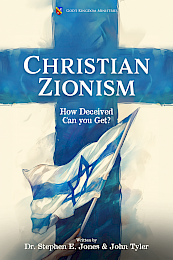
Read a variety of tracts that condense a topic into a short, single page format. These tracts can be read for free online, or physical copies can be purchased in bundles. If you are subscribed to the FFI Newsletter, you will receive new tracts when they are released.
View Full Tract List1 Peter 1:17-19 says,
17 If you address as Father the One who impartially judges according to each one’s work, conduct yourselves in fear during the time of your stay on earth; 18 knowing that you were not redeemed with perishable things like silver or gold from your futile way of life inherited from your forefathers, 19 but with the precious blood, as of a lamb unblemished and spotless, the blood of Christ.
As children of God, begotten by the Spirit and not after the flesh, we have the right to address God as “Father.” Jesus said the same thing many times, as, for example, in Matthew 5:45. Jesus too often addressed Him as “My Father,” as, for example, in Matthew 11:27. Others may know Jesus as a Prophet, a Teacher, a King, or even as a God, but only those who have been begotten by the seed of the word have the biblical right to address Him as Father.
It is a matter of relationship. It is about family, not merely about friendship or acquaintance. Servants are good, but they are not heirs. In fact, even the sons cannot inherit until they have matured (Galatians 4:1, 2). They must be begotten through a Passover experience; they must learn obedience through Pentecost; they must finally be pronounced spiritually mature through Tabernacles. Only then are they qualified to reign with Christ in the Kingdom. To reign with Christ is to obtain the birthright inheritance. All other believers are mere citizens.
To reign is, in part, to be placed in the position of a judge. God’s judges must be impartial, because they must reflect the mind and will of the Impartial Judge who has positioned them as judges. So also do we read in James 2:8, 9,
8 If, however, you are fulfilling the royal law according to the Scripture, “You shall love your neighbor as yourself,” you are doing well. 9 But if you show partiality, you are committing sin and are convicted of the law as transgressors.
It was commonly thought among the Jews in Jesus’ time that one’s “neighbor” was a fellow Jew only. A lawyer came to him one day and asked him, “And who is my neighbor?” (Luke 10:29). Jesus answered him with the parable about the Good Samaritan. The point of this was to show that one’s neighbor extended beyond a fellow Jew. If a Samaritan showed compassion for a man who had been beaten and robbed, then he was being neighborly, as it were. To be neighborly was to fulfill the law.
Jesus said, in effect, that if men were partial in applying the law of love, they were violating the second great commandment, “You shall love your neighbor as yourself” (Leviticus 19:18). This formed the basis of James’ teaching as well as Peter’s. In the first century, there was great tension and hatred between Jews and Samaritans, so this hit the religious system especially hard. God judged both groups impartially. Jews could not argue that they were “chosen” while the Samaritans were not, for this was race-based theology.
Peter’s instruction to these ex-Israelites of the dispersion was to remind them gently that God had cast out their forefathers from Israel for the same reason that He had expelled the Canaanites earlier. Both were guilty of the same offenses, and God was an impartial Judge. So we read in Deuteronomy 8:19, 20,
19 It shall come about if you ever forget the Lord your God and go after other gods and serve them and worship them, I testify against you today that you will surely perish. 20 Like the nations that the Lord makes to perish before you, so you shall perish; because you would not listen to the voice of the Lord your God.
We know, of course, that this is precisely what happened some centuries later. We read of this in 2 Kings 17:17, 18,
17 Then they made their sons and their daughters pass through the fire, and practiced divination and enchantments, and sold themselves to do evil in the sight of the Lord, provoking Him. 18 So the Lord was very angry with Israel and removed them from His sight; none was left except the tribe of Judah.
Peter’s audience already knew this. If they had forgotten their history, there is no doubt that Peter had reminded them earlier when he visited them and brought them to Christ. These ex-Israelites were expected to come into agreement with God’s judgment, turn from their sins, and follow this new way of life as sons of God. Everyone, whether Jew, Israelite, or other, must come to God in the same way, equally and impartially according to the revelation in Isaiah 56:7, 8,
7 … For My house will be called a house of prayer for all the peoples. 8 The Lord God, who gathers the dispersed of Israel, declares, “Yet others I will gather to them, to those already gathered.”
Provision was made from the beginning for foreigners to become Israelites. Abraham’s household included thousands of people who were not his biological descendants. Paul calls them the household of faith, because Abraham was the father of faith. These went with Jacob to Egypt (Genesis 46:1) and soon were fully integrated into the tribes of Israel. Later, Moses led the Israelites out of Egypt, and “a mixed multitude also went up with them” (Exodus 12:38). These did not remain separate from the tribes of Israel either but were integrated into whatever tribe they chose.
Hence, Isaiah’s prophecy was fully conformed to the mind and will of God from the beginning. It was only later, due to hatred, war, and competition, that the idea of Israel’s exclusivity lodged in the minds of the people. They came to believe that God was partial toward them on the basis of their supposed biological descent from Abraham. This mindset continues to this day and is affirmed every time someone asserts that “the Jews are God’s chosen people.”
That is a statement from those who believe in a God of partiality. But Peter, who was an apostle to the circumcision, told the ex-Israelites of the dispersion that God was impartial and that anyone may be begotten by God and refer to Him as their Father. Sons are heirs, and mature sons are chosen and called to reign with Christ in the Age to come, regardless of their ethnicity.
Peter then reminded these ex-Israelites that they were redeemed not with perishable money but “with His precious blood… the blood of Christ.” Once again, Peter distinguishes between carnal, earthly business practices and spiritual matters. The principle of redemption is the same, but the application is far different so as to be impartial and inclusive of all men.
This divine plan was not an afterthought but was formulated from the beginning of creation. So 1 Peter 1:20, 21 says,
20 For He was foreknown before the foundation of the world, but has appeared in these last times for the sake of you 21 who through Him are believers in God, who raised Him from the dead and gave Him glory, so that your faith and hope are in God.
This redemption plan is faith-based, not race-based. It does not apply to the children of earthly fathers but to the children of our heavenly Father.
1 Peter 1:22 continues,
22 Since you have in obedience to the truth purified your souls for a sincere love of the brethren, fervently love one another from the heart.
This refers again to the second great commandment: “You shall love your neighbor as yourself.” Learning the truth of God’s word brings us to the place of obedience to His will, and this process is called sanctification (or holiness). To love one another, Peter implies, is to treat the brethren with impartiality—not claiming preference on account of one’s genealogy.
1 Peter 1:23 says,
23 for you who have been born [gennao, “begotten”] again not of seed which is perishable but imperishable, that is, through the living and enduring word of God…
Men beget; women give birth. The Greek word gennao has this double meaning, and one must see the context to know how to translate it properly. In this case Peter was speaking of “seed,” which refers to begetting, not to birth. We have not been brought to birth by seed; we have been begotten by the Father’s imperishable (immortal) seed. It is not physical seed, as in natural impregnation, for that would merely produce mortal children. Like begets like.
The seed of God is “the living and enduring word of God,” which, if received (believed), begets the children of God. That holy seed (child) is a son of God in the same manner that Jesus was begotten by God (Matthew 1:18). In Luke 1:35 the angel told the Virgin Mary,
35 The angel answered and said to her, “The Holy Spirit will come upon you, and the power of the most High will overshadow you; and for that reason the holy Child shall be called the Son of God.”
For the same reason, those who have begotten by the Holy Spirit will also be called sons of God. The main difference is that Jesus was the Son of God from the beginning, while the rest of us have to be begotten again, or a second time, because the first time we were begotten by mortal seed from our earthly fathers.
1 Peter 1:24, 25 continues,
24 for, “All flesh is like grass, and all its glory like the flower of grass. The grass withers, and the flower fall off, 25 but the word of the Lord endures forever.” And this is the word which was preached to you.
Here Peter was quoting from Isaiah 40:6-8,
6 A voice says, “Call out.” Then he answered, “What shall I call out?” All flesh is grass, and all its loveliness is like the flower of the field. 7 The grass withers, the flower fades, when the breath of the Lord blows upon it; surely the people are grass. 8 The grass withers, the flower fades, but the word of our God stands forever.
Fleshly people can be beautiful for a season, but in the end, mortality overcomes the flesh. Such is “grass” and “flower of the field.” Those who are born from earthly parents are born mortal. But “the word of our God,” which is the seed of our heavenly Father, “stands forever.” Hence, that inner child that is begotten by God is immortal, even though one’s fleshly identity is not.
The question is this: Which child is the real you? Have you, by faith, received the enduring seed of the word? Where is the seat of your conscious identity? Which child do you claim as your true identity? Do you claim to be a fleshly son of Abraham, Isaac, and Jacob, who were all mortal? Or do you claim to be a son of God, begotten by your heavenly Father through the word of the gospel? The divine court will treat you according to who you claim to be.
That is the real issue.

Dr. Stephen Jones has been writing blog posts since 2005 on a variety of topics from Bible Studies to World News, and he has been writing books since 1992. Dr. Jones' most important writings came after God brought him back into the full-time ministry in 1991. It is here that all his earlier years of searching the Scriptures began to come into clear focus. He combines a knowledge of the Old and New Testaments with a personal revelation of God that began and developed during the "wilderness" period of his life, which he often refers to as God's True Bible College... Read More
We are only able to do what we do because of your support. If you feel led to support this ministry, we deeply appreciate it