Latest Posts
View the latest posts in an easy-to-read list format, with filtering options.
View the latest posts in an easy-to-read list format, with filtering options.
Multi-part posts on a particular topic, grouped together in "series" pages.
Look through our blog archive by year / month, or in a massive title list.
10/06/2026 - Having exposed the political nature of the Little Horn’s religious beast empire, we can more... Read More
10/05/2026 - When the Israelites wanted flesh to eat, God gave them their desire but it made them sick. Psalm 1... Read More

10/02/2026 - Estonia, one of Europe’s tiny Baltic nations, is being applauded for banning all grain shipm... Read More
Read over 100 books written by Dr. Jones, available to read for free online. Several of the books have also been translated into different languages, and are also available to read for free. The only time you pay is when you purchase a physical version of a book.
View Full Book List
Read a variety of tracts that condense a topic into a short, single page format. These tracts can be read for free online, or physical copies can be purchased in bundles. If you are subscribed to the FFI Newsletter, you will receive new tracts when they are released.
View Full Tract List1 Thessalonians 4:15-17 says,
15 For this we say to you by the word of the Lord, that we who are alive and remain until the coming of the Lord, will not precede those who have fallen asleep. 16 For the Lord Himself will descend from heaven with a shout, with the voice of the archangel and with the trumpet of God, and the dead in Christ will rise first. 17 Then we who are alive and remain will be caught up together with them in the clouds to meet the Lord in the air, and so we shall always be with the Lord.
These three verses give Paul’s “word of the Lord” regarding the sequence of events at the coming (parousia) of Christ, beginning with the first resurrection. The sequence itself is a commentary on the Autumn feast days, which establish the order of events surrounding the parousia.
The Spring feasts prophesy of the dates and the order of events in regard to Christ’s first coming. The Autumn feasts do the same in regard to His second coming. Any prophecy teacher who does not understand the prophetic feast days is severely handicapped when teaching about the second coming of Christ. Unfortunately, when Darby developed his “rapture” theory in the 1850’s, he did not understand or take into account the Autumn feasts and their sequence of events.
The Thessalonians apparently feared that believers who died before the parousia might miss some privilege enjoyed by those who remained alive. Paul reverses their concern. The dead are not late. They go first, because the dead in Christ are to be raised on the feast of Trumpets, on the first day of the seventh month. Leviticus 23:24 says,
24 Speak to the sons of Israel, saying, “In the seventh month on the first of the month you shall have a rest, a reminder by blowing [tᵊrûʿâ] of trumpets, a holy convocation.”
The Hebrew word tᵊrûʿâ is from the root word rûaʿ, meaning, “to shout, raise a sound, cry out, give a blast.”
https://www.blueletterbible.org/lexicon/h7321/nasb95/wlc/0-1/
No doubt Paul had this word in mind when he told the Thessalonians that Christ will “descend from heaven with a shout.” The word also applied to a war-cry, or a signal for war. Hence, Numbers 10:9 says, “when you go to war… you shall sound an alarm with the trumpets.”
The trumpet itself was not a shofar (or ram's horn) but a silver trumpet which Moses had invented and built in Numbers 10:1-10. Josephus, in his Antiquities of the Jews3.12.6 (§291), discusses Numbers 10, saying,
“Moses was the inventor of the form of their trumpet, which was made of silver.”
He then describes it as a little less than a cubit long, consisting of a narrow tube somewhat thicker than a flute, with an opening suitable for the mouth, and ending “in the form of a bell, like common trumpets.”
Whiston's translation says:
“Moses was the inventor of the form of their trumpet.”
He implies that Moses was the first to design trumpets in the shape of a bell at the end.
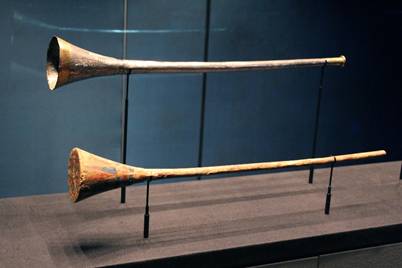
Numbers 10 tells us that Moses built two trumpets. When they blew a single trumpet, it signaled a gathering of the leaders or rulers. Both trumpets signaled the gathering of the entire congregation (or church).
When Paul speaks of the parousia of Christ, he uses “trumpet” in the singular in 1 Thessalonians 4:16 and in 1 Corinthians 15:52. In each case the trumpet summons the leaders only, that is, the overcomers who are raised in the first resurrection. John foresaw how these “came to life and reigned with Christ for a thousand years” (Revelation 20:4). This is repeated in verse 6.
The implication is that the general resurrection of the dead (Revelation 20:12) will occur with the sound of two trumpets, although John does not mention this detail. Yet John says specifically in Revelation 20:5,
5 The rest of the dead did not come to life until the thousand years were completed. This is the first resurrection.
Hence, it is a limited resurrection.
The law, however, is not merely a moral document; it is prophetic as well, and the feast days reveal not only a prophesied event but also the timing of its fulfillment.
For example, Passover prophesied of Christ’s death on the cross, and so He had to die while the people were killing the lambs on the afternoon of the 14th days of the first month on the Hebrew calendar. Likewise, He was raised on the day of the wave-sheaf offering, and Pentecost (the feast of Weeks) was fulfilled seven weeks later at the appointed time.
The point is that the current rapture theory teaches that the entire church will be raised in the first resurrection—as if two trumpets were blown. Darby obviously did not understand the prophecy in Numbers 10.
On the first day of each month, a priest blew a trumpet to proclaim the event and to fix the calendar accordingly. The first day of the seventh month dated the feast of Trumpets. Hence, this was the seventh trumpet—also known as “the last trumpet” (1 Corinthians 15:52) that encompassed the Mosaic feast days. It was traditionally the first day of creation, and in prophecy it is the opening event in the sequence of Christ’s parousia.
The feast of Trumpets marks the start of the New Creation Order, beginning with the resurrection of those called to reign with Christ during the Age of Tabernacles. There will be many others on earth during this time—otherwise, who would they reign over? Their task will be to build a new earth, a new order of the ages—the Kingdom of God.
There will also be many believers alive at the time who did not meet the requirements of an overcomer. They will not lose their salvation, but they will have to await the general resurrection to receive their reward. Jesus tells us this in John 5:28, 29,
28 Do not marvel at this, for an hour is coming, in which all who are in the tombs will hear His voice, 29 and come forth; those who did the good deeds to a resurrection of life, those who committed the evil deeds to a resurrection of judgment.
This is the general resurrection of “all who are in the tombs” mentioned in Revelation 20:12. We see also how this resurrection will include some who will receive “a resurrection of life.” In other words, it will include believers in Christ. This explains why the “book of life” is opened at that time. John implies the presence of believers also, when he says in verse 15, “if anyone’s name was not found written in the book of life, he was thrown into the lake of fire.”
There would be no purpose for opening the book of life if only unbelievers were present in the general resurrection.
Paul testifies again in Acts 23:14, 15 of his belief in a general resurrection:
14 But this I admit to you, that according to the Way which they call a sect I do serve the God of our Fathers, believing everything that is written in accordance with the Law and that is written in the Prophets; 15 having a hope in God, which these men cherish themselves, that there shall certainly be a resurrection of both the righteous and the wicked.
He does not say that there will be a resurrection for each; he speaks only of a single resurrection for “both the righteous and the wicked.”
Hence, at the parousia of Christ, a limited number of believers will be raised from the dead on the feast of Trumpets. When we see this event, then we know that a sequence of events will occur in the following three weeks, ending with the eighth day of Tabernacles. This is the message prophesied in the Autumn feast days.

Dr. Stephen Jones has been writing blog posts since 2005 on a variety of topics from Bible Studies to World News, and he has been writing books since 1992. Dr. Jones' most important writings came after God brought him back into the full-time ministry in 1991. It is here that all his earlier years of searching the Scriptures began to come into clear focus. He combines a knowledge of the Old and New Testaments with a personal revelation of God that began and developed during the "wilderness" period of his life, which he often refers to as God's True Bible College... Read More
We are only able to do what we do because of your support. If you feel led to support this ministry, we deeply appreciate it