Latest Posts
View the latest posts in an easy-to-read list format, with filtering options.
View the latest posts in an easy-to-read list format, with filtering options.
Multi-part posts on a particular topic, grouped together in "series" pages.
Look through our blog archive by year / month, or in a massive title list.
10/08/2026 - Ezekiel 1:1-3 begins, 1 Now it came about in the thirtieth year, on the fifth day of the fourth mo... Read More
10/07/2026 - Ezekiel is a book of judgment, restoration, and the glory of God. It explains why Jerusalem was be... Read More
10/06/2026 - Having exposed the political nature of the Little Horn’s religious beast empire, we can more... Read More
Read over 100 books written by Dr. Jones, available to read for free online. Several of the books have also been translated into different languages, and are also available to read for free. The only time you pay is when you purchase a physical version of a book.
View Full Book List
Read a variety of tracts that condense a topic into a short, single page format. These tracts can be read for free online, or physical copies can be purchased in bundles. If you are subscribed to the FFI Newsletter, you will receive new tracts when they are released.
View Full Tract ListEzekiel 1:1-3 begins,
1 Now it came about in the thirtieth year, on the fifth day of the fourth month, while I was by the river Chebar among the exiles, the heavens were opened and I saw visions of God. 2 (On the fifth of the month in the fifth year of King Jehoiachin’s exile, 3 the word of the Lord came expressly to Ezekiel the priest, son of Buzi, in the land of the Chaldeans by the river Chebar; and there the hand of the Lord came upon him.)
The “thirtieth year” was the year of the 17th Jubilee cycle, dating back to the Jordan crossing. The 16th Jubilee Year was from 623-622 B.C. It was also the first year of the 17th Jubilee cycle, because the 50th year was also the first year of the next cycle.
The 30th year of the 17th Jubilee cycle was five years after Jehoiachin had been exiled, along with 7,000 other Judahites. Since Jehoiachin was exiled in 597 B.C., the fifth year of his exile is dated 593-592 B.C. More specifically, this “word of the Lord” came to the prophet “on the fifth day of the fourth month,” which was in July, 592 B.C.
A common interpretation of “the thirtieth year” is that Ezekiel was thirty years old. This would be significant for a priest. Numbers 4:3 associates thirty with the beginning of the service described there for the Kohathite Levites. If this was when Ezekiel began his priestly ministry, then it would mean that he was born in the year of the 16th Jubilee (623-622). Hence, Jeremiah’s ministry, in a sense, was to call Judah to repent and thereby avoid exile, while Ezekiel’s ministry was to deal with the people in exile.
In fact, we might speculate that “the fifth day of the fourth month” was Ezekiel’s 30th birthday.
So Ezekiel’s priestly (and prophetic) ministry was launched six years before Jerusalem was destroyed (586 B.C.). Zedekiah was the vassal king in Jerusalem, having been appointed by Nebuchadnezzar to replace Jehoiachin in 597. Zedekiah would soon revolt (589), contrary to the word of the Lord (Jeremiah 27:12). This resulted in the final siege of Jerusalem (588), ending with its destruction (586).
The opened heavens and Ezekiel’s vision, then, should be understood in the context of the soon-coming disaster and the wholesale exile of the survivors to Babylon.
If the age interpretation is correct, Ezekiel received his prophetic commission at a fitting time for sacred service. Instead of serving at Jerusalem’s temple, he was called to minister among the captives. His priesthood helps explain the book’s concern with holiness, defilement, the sanctuary, and the restoration of acceptable worship.
Ezekiel’s name, “God strengthens,” suits the difficult ministry that follows. He would need divine strength to confront a rebellious people and bear the burden of the prophetic signs God required. Priestly and prophetic ministries are much easier under godly government and with a righteous population. But these people had been exiled on account of their rebellious hearts.
The location is equally important. God opened heaven to Ezekiel in Babylonia. Exile had removed the people from their homeland and sanctuary, but it had not placed them beyond God’s jurisdiction or His ability to reveal Himself. In those days many believed that gods were local deities who ruled specific territories or nations. (This belief is seen in 2 Kings 17:25-27.)
“The heavens were opened” introduces a disclosure of the heavenly realm. Ezekiel does not merely offer his own assessment of the captivity; he presents what God enabled him to see. The vision that follows reveals the divine throne as active and mobile, showing that God’s government is not confined to Jerusalem—or any other earthly city.
Ezekiel 1:4–10 introduces the living creatures that accompany God’s throne. The vision reveals divine power, holiness, and purposeful movement. Ezekiel later identifies these creatures as cherubim (Ezekiel 10:20), connecting the vision with the guardians of Eden’s Tree of Life (Genesis 3:24) and the figures above the ark’s mercy seat (Exodus 25:20).
This also suggests a connection between Eden and the glory resting upon the mercy seat in the tabernacle. Not only was the mercy seat God’s throne on earth, it was also the source of life. So John 1:4 tells us, “In Him was life, and the life was the Light of men.” This was John’s introduction to the glory of God manifested in eight miracle-signs, beginning in John 2:11,
11 This beginning of His signs Jesus did in Cana of Galilee, and manifested His glory, and His disciples believed in Him.
In Ezekiel 1:4 the prophet sees a storm wind coming from the north, a great cloud, and flashing fire surrounded by brightness. Within the fire is something resembling glowing metal.
4 As I looked, behold, a storm wind was coming from the north, a great cloud with fire flashing forth continually and a bright light around it, and in its midst something like glowing metal in the midst of the fire.
The prophet was looking north as this “cloud with fire” moved south toward him. Four living creatures emerge from the fiery cloud. Their overall appearance resembles a human figure, but each has four faces and four wings.
Their legs are straight, and their feet resemble a calf’s hoof, gleaming like polished bronze. Ezekiel describes firm, radiant supports beneath the creatures. Ezekiel 1:5, 6 says,
5 Within it there were figures resembling four living beings. And this was their appearance: they had human form. 6 Each of them had four faces and four wings.
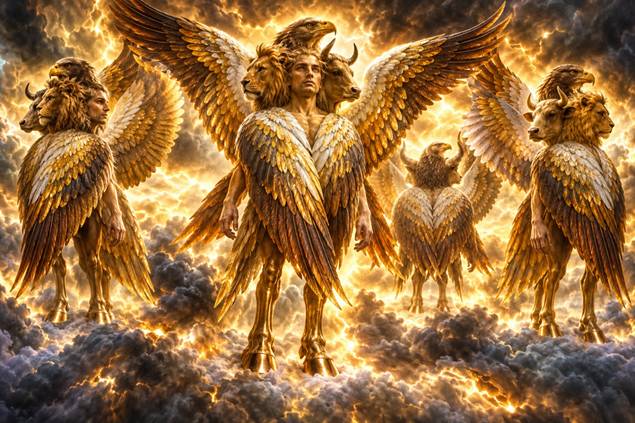
The four cherubim were pictured in verse 10 as a man, a lion, a bull, and an eagle.
10 As for the form of their faces, each had the face of a man; all four had the face of a lion on the right side and the face of a bull on the left, and all four had the face of an eagle.
It appears that these four cherubim each depicted the same four living creatures. As the scene moved toward the prophet, the first “face” he saw was that of a man. The man was positioned on the south side. To the right was the lion; to the left was the bull; the eagle (carrying away a serpent) was in the rear, that is, on the north side. These were the four banners of these leading tribes surrounding the tabernacle of Moses.
The locations and tribal groupings are explicit in Numbers 2:3–31. The identification of their banners with the lion, man, ox, and eagle comes from interpretive tradition; Numbers itself does not describe the pictures on the standards. Keil and Delitzsch record this tradition and connect it with Ezekiel’s four faces.
The wilderness camp of Israel provides a meaningful earthly counterpart to Ezekiel’s vision. Israel surrounds God’s dwelling (the tabernacle) under four leading standards, while the cherubim accompany His heavenly throne. The comparison becomes especially striking when we use the traditional symbols associated with those standards.
There is also an important distinction: Ezekiel does not assign one tribal symbol to each cherub. Each of the four cherubim bears all four faces. The camp distributes the symbols among four divisions; the vision unites them within each living creature. Read symbolically, the cherubim express the coordinated unity of the whole camp under God’s government.
The key concept is expressed later as a prophetic restoration of Kingdom unity under Christ’s rule. Ezekiel 37:16, 17,
16 And you, son of man, take for yourself one stick and write on it, “For Judah and for the sons of Israel, his companions; then take another stick and write on it, “For Joseph, the stick of Ephraim and all the house of Israel, his companions.” 17 Then join them for yourself one to another into one stick, that they may become one in your hand.
Judah is called a lion in Genesis 49:9, while Deuteronomy 33:17 compares Joseph to a firstborn bull whose two horns represent Ephraim and Manasseh. This also fits our discussion of Judah’s Dominion Mandate and Joseph’s Fruitfulness Mandate. For Dan, Genesis 49:17 supplies the serpent imagery.
The eagle—and particularly an eagle carrying away a serpent—is an additional symbolic interpretation, rather than a banner description supplied by Scripture. Many years later, however, King Areus of Sparta, who discovered that he was descended from Israelite immigrants, wrote a letter to Onias, who, in the third century B.C., was the high priest in Jerusalem.
The letter depicted the seal of Dan, and Josephus records the description: “the seal is an eagle with a dragon [or serpent] in his claws” (Antiquities of the Jews, XII, iv, 10). That banner of the tribe of Dan pictured the ultimate removal of the serpent from their midst, being pictured finally in Revelation 20:10, as well as in the prophetic story in Acts 28:3-5.
The prophecy of Kingdom unity around the throne of God can be fulfilled only when all accept the rule of the Messiah, the Heir of all things. Ezekiel 37:24-28 says,
24 My servant David will be king over them, and they will all have one shepherd; and they will walk in My ordinances and keep My statutes and observe them… 27 My dwelling place also will be with them; and I will be their God, and they will be My people. 28 And the nations will know that I am the Lord who sanctifies Israel, when My sanctuary is ins their midst forever.
The central connection is therefore God dwelling and ruling in the midst of His people. The tabernacle stood at the center of Israel’s ordered camp; Ezekiel sees the heavenly throne accompanied by living creatures bearing the corresponding forms. In captivity, that vision would proclaim that the divine government represented in Israel’s wilderness arrangement was still active, even outside the land. He is not a mere local deity; He is, in fact, “the God of the whole earth” (Isaiah 54:5). We read in 1 Corinthians 15:27, 28 that this is Jesus Christ.

Dr. Stephen Jones has been writing blog posts since 2005 on a variety of topics from Bible Studies to World News, and he has been writing books since 1992. Dr. Jones' most important writings came after God brought him back into the full-time ministry in 1991. It is here that all his earlier years of searching the Scriptures began to come into clear focus. He combines a knowledge of the Old and New Testaments with a personal revelation of God that began and developed during the "wilderness" period of his life, which he often refers to as God's True Bible College... Read More
We are only able to do what we do because of your support. If you feel led to support this ministry, we deeply appreciate it