Latest Posts
View the latest posts in an easy-to-read list format, with filtering options.

View the latest posts in an easy-to-read list format, with filtering options.
Multi-part posts on a particular topic, grouped together in "series" pages.
Look through our blog archive by year / month, or in a massive title list.
10/12/2026 - Ezekiel 1:13–21 presents God’s throne as living, active, and perfectly governed by His... Read More
10/09/2026 - Israel encampment in the wilderness mirrored Ezekiel’s vision of the four living creatures.... Read More
10/08/2026 - Ezekiel 1:1-3 begins, 1 Now it came about in the thirtieth year, on the fifth day of the fourth mo... Read More
Read over 100 books written by Dr. Jones, available to read for free online. Several of the books have also been translated into different languages, and are also available to read for free. The only time you pay is when you purchase a physical version of a book.
View Full Book List
Read a variety of tracts that condense a topic into a short, single page format. These tracts can be read for free online, or physical copies can be purchased in bundles. If you are subscribed to the FFI Newsletter, you will receive new tracts when they are released.
View Full Tract ListEzekiel 1:13–21 presents God’s throne as living, active, and perfectly governed by His Spirit. The fire displays His holiness, while the wheels show that His authority can move wherever He wills. For Ezekiel, seeing this in Babylon meant that God’s presence and government were not confined to Jerusalem.
Ezekiel 1:13 says,
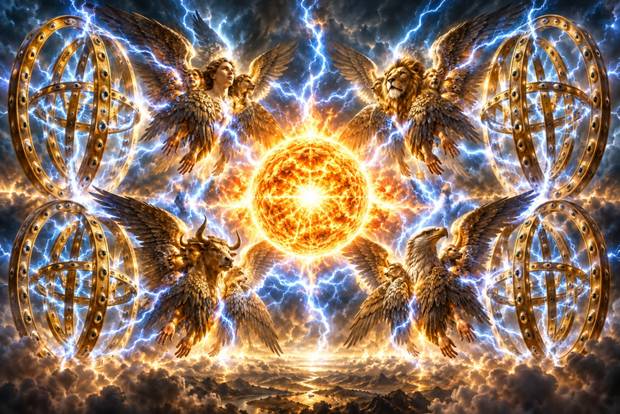
13 In the midst of the living beings there was something that looked like burning coals of fire, like torches darting back and forth among the living beings. The fire was bright, and lightning was flashing from the fire.
Ezekiel describes burning coals, torches, and lightning moving among the creatures. This recalls the fire associated with God’s presence at Sinai and the pillar of fire that guided Israel through the wilderness. Moses’ description of God’s manifestation at Sinai is found in Deuteronomy 4:12, 24 in this way:
12 Then the Lord spoke to you from the midst of the fire; you heard the sound of words, but you saw no form—only a voice… 24 For the Lord your God is a consuming fire, a jealous [qanna’, or cana, “zealous, passionate”] God.
Qannaʾ (קַנָּא) belongs to the Hebrew root q-n-ʾ, which expresses both jealousy and zeal. These ideas overlap in a passionate concern for a person, relationship, or rightful claim.
The related noun qinʾah is translated “zeal” in Isaiah 9:7: “The zeal of the LORD of hosts will accomplish this.”
In Deuteronomy 4:24, “jealous” is especially appropriate because the context concerns covenant faithfulness and the prohibition of idols. But God’s zeal for His covenant and His people is inherent in that jealousy. One could understand this as: a God zealous for the exclusive allegiance of His covenant people.
In the gospel of John, chapter 2, the first miracle-sign that Jesus performed was at the wedding feast of Cana (John 2:1). Each of the eight signs in John’s gospel are followed by a historical incident that illustrates and explains the sign itself. In this case, the incident is the cleansing of the temple in John 2:13-21. So we read in John 2:17,
17 His disciples remembered that it was written [in Psalm 69:9], “Zeal for Your house will consume Me.”
John uses the Greek term zelos to translated the Hebrew word qin’ah used in Psalm 69:9. It is important to connect the wedding feast of Cana to the cleansing of the temple. Qanna’ and qin’ah are best understood as zealous passions, especially within the context of a marriage covenant. God is passionate about the faithfulness and purify of His marriage covenant. The purification jars at Cana (John 2:6) also make purification one of the main themes.
Thus, Jesus’ cleansing of the temple expresses the covenant zeal of the “jealous God.” He defends His Father’s house against its corruption.
There is also a suggestive connection between the two events themselves. At Cana, Jesus supplies wine for a wedding, which brought joy through a transformative miracle; at Jerusalem, He zealously cleanses His Father’s house. Read together through the covenant-marriage theme, they portray the One who provides the wine (joy) for the marriage and zealously guards the holiness of the relationship.
Three years later, Jesus cleansed the temple again (Mark 11:15-17). Five days later, He was crucified. Why? Because cleansing a place of worship does not remove idolatry and corruption from the hearts of men. Nonetheless, the event foreshadowed a future cleansing of the house of God. The church will be cleansed by the fire of divine judgment.
Fire reveals His presence. He purifies and executes judgment through His “fiery law” (Deuteronomy 33:2 KJV).
The burning coals also anticipate Ezekiel 10:2, where coals taken from among the cherubim are scattered over Jerusalem. Thus, the fire in this opening vision prepares us for the judgment described later in the book. The throne from which God governs is also the source of the judgment that will expose and consume Jerusalem’s corruption.
Yet fire has a cleansing function as well. In Isaiah 6:6–7, a coal from the altar touches the prophet’s lips and removes his iniquity. This anticipates Paul’s assertion in 1 Corinthians 3:16, “you are a temple of God.” These prophetic pictures show how God’s holiness both judges sin and prepares people for His service.
Perhaps the clearest biblical expression of the fire of God is seen at the final judgment in Daniel 7:9, 10,
9 I kept looking until thrones were set up, and the Ancient of Days took His seat; His vesture was like white snow and the hair of his head like pure wool. His throne was ablaze with flames, its wheels were burning fire. 10 A river of fire was flowing and coming out from before Him; thousands upon thousands were attending Him, and myriads upon myriads were standing before Him the court sat, and the books were opened.
The judgments of the law were thus pictured as “a river of fire” flowing upon those being resurrected to judgment. In Revelation 20, this “river” forms a “lake of fire,” which is the actual implementation and outworking of the legal proceedings and verdicts from the river of fire.
The creatures move with the appearance of lightning in Ezekiel 1:14,
14 And the living beings ran to and fro like bolts of lightning.
The emphasis is on their extraordinary speed and responsiveness. When God directs them, they act immediately without delay at the speed of lightning.
Ezekiel 1:15-17 says,
15 Now as I looked at the living beings, behold, there was one wheel on the earth beside the living beings, for each of the four of them. 16 The appearance of the wheels and their workmanship was like sparkling beryl; and all four of them had the same form; their appearance and workmanship being as if one wheel were within another. 17 Whenever they moved, they moved in any of their four directions without turning as they moved.
Ezekiel sees a “wheel on the earth” beside each living creature. The vision joins the heavenly throne to activity on earth: God’s heavenly government reaches into the world where nations rise, fall, and carry His people into captivity. In fact, the throne of God Himself is not the only throne. Daniel 7:9 says that “thrones were set up.” This is confirmed in Revelation 20:4, “I saw thrones, and they sat on them, and judgment was given to them,” that is, the overcomers.
In God’s perfect government, the throne of heaven is fully coordinated with the thrones on earth that are given to the overcomers who are raised in the first resurrection.
All four wheels have the same appearance, indicating a coordinated arrangement. Their gleaming appearance, compared to beryl (in the NASB), contributes to the splendor of the vision.
The unusual feature is “one wheel within another” (verse 16). Verse 17 explains its practical significance: the wheels can move in any of four directions without turning. An arrangement of intersecting wheels is a common way to visualize this, although Ezekiel does not supply enough mechanical detail to reconstruct it confidently.
The theological point is clearer than the mechanism: God’s throne can move freely in every direction. His government encounters no geographical boundary. Babylon is under His authority just as surely as Jerusalem.

Dr. Stephen Jones has been writing blog posts since 2005 on a variety of topics from Bible Studies to World News, and he has been writing books since 1992. Dr. Jones' most important writings came after God brought him back into the full-time ministry in 1991. It is here that all his earlier years of searching the Scriptures began to come into clear focus. He combines a knowledge of the Old and New Testaments with a personal revelation of God that began and developed during the "wilderness" period of his life, which he often refers to as God's True Bible College... Read More
We are only able to do what we do because of your support. If you feel led to support this ministry, we deeply appreciate it